
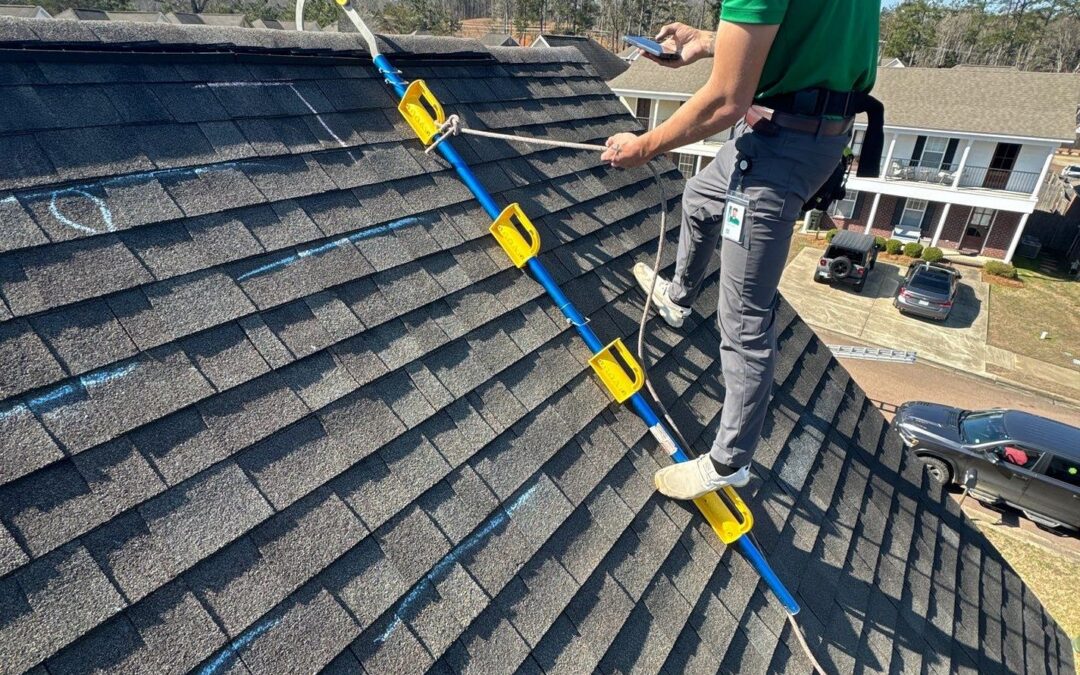
If you’re wondering how to tell if your roof has storm damage, start with fast visual clues and interior checks. Look for dented metal, creased or missing shingles, and fresh water stains after wind‑driven rain. Photograph everything, then schedule a storm damage roof inspection with a licensed local contractor to verify and document issues. Click here for a free roof estimate!
Quick Answer: Signs Your Roof Has Storm Damage
Signs of roof storm damage include:
- Dented metal: Dings on gutters, downspouts, vents, or flashing are classic hail indicators.
- Creased shingles: Horizontal lines near shingle tops show wind uplift that weakens the mat.
- Missing or torn shingles: Wind damage to roof coverings leaves underlayment exposed.
- Granule piles: Excess granules in gutters/downspouts signal hail damage to roof surfaces.
- Impact marks: Dark spots, bruises that feel soft, or exposed black asphalt on shingles.
- Flashing movement: Bent, lifted, or unsealed flashing at chimneys, walls, valleys, and skylights.
- Active leaks: New ceiling stains, damp attic insulation, or musty odors after a storm.
- Debris impacts: Punctures or broken tiles from falling branches or wind‑blown debris.
- Vent and ridge damage: Cracked plastic vents, loose ridge caps, or popped nails.
- Ice dam lines: Distortion or staining at eaves after winter storms.
Next steps: Photograph damage from the ground, then call a licensed roofer for a storm damage roof inspection and written report. If damage aligns with recent weather, discuss whether to file a storm damage insurance claim with your carrier.
What Different Storms Do to U.S. Roofs
Different storms stress roofs in different ways. Hail can bruise asphalt mats and dent soft metals. High winds break shingle bonds and can lift edges or remove entire tabs. Wind‑driven rain pushes water into capillary gaps beneath shingles and flashing. Winter storms create ice dams that back water up under the roofing and soak underlayment and decking.
Tropical systems (tropical storms and hurricanes): Long‑duration, high‑gust winds, wind‑borne debris, and sustained wind‑driven rain can exploit even small flashing gaps. Pressure differentials can peel roof coverings, especially on edges and corners. Salt spray in coastal zones can accelerate corrosion of fasteners and flashing.
Microbursts and straight‑line winds: Localized, intense downdrafts can exceed 60–80 mph in bursts, tearing shingles, bending ridge vents, and driving rain into sidewall transitions. Short, violent events often leave clear wind direction patterns in damage.
Storm directionality: Windward slopes typically show the worst shingle creasing and edge lifting, while leeward slopes can still experience suction that breaks sealant bonds and loosens ridge caps.
How to Check for Hail Damage on Asphalt Shingles
Hail damage to roof surfaces can be subtle from the ground. Start with collateral signs: dents in downspouts, dings on metal vents, damaged window screens, chipped paint on decks/rails, and bent soft metal caps or AC condenser fins. Photograph hailstones with a coin for scale if you can do so safely.
- Granule loss: Look for peppered spots or bare areas exposing black asphalt; check gutters for granule buildup.
- Bruising: Gently press suspected impact points; soft or spongy spots suggest mat damage.
- Cracks or tears: Larger hail or aged shingles may show radial cracks or torn tabs.
- Collateral metal dents: Dented flashing and vents corroborate hail impact energy.
Think of a hail bruise like a bruise on an apple: the skin looks scuffed, but the softened layer beneath is the real problem. Over freeze‑thaw cycles, bruised mats can propagate into cracks, accelerating leaks and aging.
How to differentiate cosmetic vs. functional hail damage
- Exposed asphalt: Granule loss revealing black asphalt indicates UV exposure and accelerated wear.
- Mat fracture: Soft spots or cracks suggest the fiberglass/asphalt mat has been compromised.
- Water absorption risk: Bruised areas can take on water, weakening adhesion over time.
- Shingle displacement: Torn or missing tabs indicate functional, not just cosmetic, damage.
Consider upgrading to UL 2218 Class 4 impact‑resistant shingles, which are tested to resist hail impacts and may qualify for insurance discounts in some regions (IBHS on hail and impact resistance).
How to Check for Wind Damage
High winds can crease shingles, break sealant bonds, and remove entire tabs. Look for lifted edges that didn’t re‑seal, displaced step flashing, and cracked plastic roof vents or loose ridge caps. On older roofs, heat‑aged sealant can make shingles more prone to uplift and non‑reseal.
Manufacturers test shingles to wind standards like ASTM D7158 and ASTM D3161. In plain language, these ratings indicate how well shingles resist wind uplift when properly installed and sealed—higher ratings generally mean better performance under strong winds.
Wind‑driven rain can exploit tiny capillary gaps around fasteners, sidewall transitions, and under laps—even when shingles look intact. You may only see a stain days later, so time‑stamped photos and notes are valuable for a storm damage insurance claim.
Wind‑Driven Rain and Hidden Leaks
- Interior clues: New ceiling stains, peeling paint, or damp drywall appearing after a storm.
- Attic clues: Darkened sheathing, wet insulation, or rusty nail tips, plus a musty odor.
- Flashing clues: Gaps at sidewalls, chimneys, skylights, or valleys where water can back up.
Mini diagnostic: 1) Do an attic sniff test for a musty smell within 24 hours. 2) Gently press a paper towel on suspect seams or nail heads during the next rain to detect moisture. 3) After the next storm, monitor stains for growth and photograph changes. Avoid contact near electrical fixtures and call a pro if water approaches wiring or lights.
Flat vs. Steep‑Slope Roofs: What to Look For by Material
Asphalt shingles
- Creased, curled, or missing tabs; granule loss and exposed asphalt; lifted edges.
- Dented soft metals (gutters, vents) corroborating hail impact.
- Loose ridge/hip caps; exposed nail heads; unsealed starter strips.
Metal roofing
- Hail dents in panels, ridge caps, and soft flashing; finish damage or chipped coating.
- Loose fasteners or backed‑out screws; seam separation on standing seam.
- Wind‑driven rain penetration at panel laps or penetrations.
Tile or slate
- Cracked, slipped, or shattered tiles/slates from impacts.
- Broken ridge tiles; displaced or corroded flashing.
- Underlayment exposure at eaves or ridges after wind uplift.
Wood shake/shingle
- Splitting or displacement; lifted shakes that didn’t re‑seat after winds.
- Granular surface erosion isn’t relevant—look for impact splits and fastener pull‑through.
- Moisture staining beneath shakes from wind‑driven rain.
Low‑slope membranes (TPO, PVC, EPDM, mod‑bit)
- Punctures from debris; seam splits or failed welds; uplifted perimeter edges.
- Ponding water and wet insulation; blistering or fishmouths at laps.
- Damaged flashing at curbs and penetrations; loose ballast on built‑up roofs.
Need help fast? Schedule a free storm damage roof inspection today. Call (555) 123‑4567 or request service online. We serve Metro City, North County, and the surrounding suburbs. Book a roof inspection after a storm.
Post‑Storm Roof Damage Checklist
Safety first: Do not climb onto the roof. Use binoculars or a telephoto lens to inspect from the ground, and keep clear of downed lines and unstable structures.
- Record the storm date, estimated hail size, and wind speed using reputable sources such as NOAA’s Storm Events Database or the Storm Prediction Center (NOAA Storm Events, NOAA SPC).
- Photograph exterior conditions: gutters, downspouts, siding, windows, decks, fences, and landscaping. Capture debris and any hailstones with a coin for scale.
- Check the attic with a flashlight for damp insulation, darkened sheathing, and water trails. Note any musty odors.
- Inspect ceilings and walls for fresh stains, bubbling paint, or peeling drywall after a roof leak after storm conditions.
- Review gutters and downspouts for dents and granule accumulation.
- If water enters, arrange professional emergency tarping and keep receipts. Learn about emergency roof tarping.
- Call a licensed, insured roofer for a storm damage roof inspection and request a photo report with repair or replacement recommendations.
- Decide whether to file a storm damage insurance claim in consultation with your contractor.
- Keep a storm file with photos, invoices, permits, and correspondence; store copies in the cloud for safekeeping.
- Download our printable checklist to follow step‑by‑step. Download the post‑storm roof checklist (PDF).
What photos to take for your claim
- Wide shots of each roof slope and elevation for context.
- Close‑ups of damage with a coin or ruler for scale.
- Collateral dents in metal (gutters, vents, flashing) and window screens.
- Slope orientation (mark north, south, east, west) and windward/leeward notes.
- Impact marks, creased shingles, lifted edges, and punctures.
- Interior water paths—stains, ceiling cracks, and attic moisture trails.
- Temporary repairs like tarps, including receipts.
- Any safety hazards (downed lines, fallen limbs) from a distance.
Professional Roof Inspection: What Pros Document
A reputable roofing contractor will survey the entire roof system—coverings, flashing, penetrations, and edges—and document storm‑specific markers like hail bruises, wind creases, and torn underlayment. They will check collateral areas (gutters, siding, HVAC, fencing) to corroborate storm direction and intensity.
Advanced assessments can include moisture meter readings on sheathing, thermal imaging to locate wet insulation, and core sampling on low‑slope roofs to verify membrane and insulation moisture. Pros also mark and photograph underlayment tears, broken shingle seals, and displaced flashing. Expect a written report with photos, slope‑by‑slope findings, and a repair vs. replacement recommendation based on roof age, extent of functional damage, and local code requirements.
Insurance Claims 101 for a Storm‑Damaged Roof
Contact your insurer promptly after the storm, provide the event date, and share your contractor’s preliminary findings. Most policies have deadlines for filing a claim—check your declarations page or call your agent to confirm timing in your state.
Understand coverage basics: Ordinance or Law pays for code‑required upgrades (like ice barrier or ventilation) when you replace damaged sections; supplements are requests to add line items that were necessary but missing from the initial estimate. Work with your contractor to align the insurer’s scope with a complete, code‑compliant repair plan.
ACV vs. RCV made simple: With Actual Cash Value (ACV), the insurer pays the depreciated amount upfront less your deductible. With Replacement Cost Value (RCV), you receive ACV first, then the insurer releases recoverable depreciation after you complete the work. Example: If a $12,000 roof has $2,000 depreciation and a $1,000 deductible, the initial payment is $9,000 (ACV minus deductible), and you receive the $2,000 depreciation after completion and invoicing.
Common claim pitfalls
- Missing line items: flashing (step, counter, kick‑out), drip edge, starter, and hip/ridge components.
- Understated ventilation or ice/water shield requirements.
- Insufficient waste factor for complex roofs.
- Omitting code upgrades covered under Ordinance or Law.
- Not matching manufacturer/spec for high‑wind fastening or underlayment.
Cross‑check every scope line by line with your contractor. For consumer guidance on claims, review resources from your state DOI and the National Association of Insurance Commissioners (NAIC).
For policy trends and severe convective storm loss data, see the Insurance Information Institute (III).
Beware of Storm Chasers and Red Flags
- High‑pressure sales tactics or “today‑only” offers.
- Promises to “eat” or waive your deductible.
- Out‑of‑state license plates with no local office or references.
- Requests to sign assignment of benefits or to endorse insurance checks before scope approval.
- No proof of insurance, licensing, or manufacturer certifications.
Repair vs. Replacement: Making the Right Call
Decisions hinge on roof age, extent and distribution of damage, material availability, and local codes. Discontinued shingles complicate repairs and can trigger matching issues. Some policies or state matching statutes address appearance—ask your insurer about provisions that apply to a storm‑damaged roof.
- Asphalt shingles: Minor repairs can be a few hundred dollars; full replacements commonly range $8,000–$25,000+ depending on size, pitch, complexity, and region.
- Metal roofing: Panel replacement/repairs vary; full replacements often range $18,000–$60,000+ based on profile and gauges.
- Tile/slate: Individual tile/slate swaps may be feasible; full replacements can range $25,000–$80,000+ with structural considerations.
- Low‑slope membranes: Repairs may be hundreds to low thousands; replacements can range $7–$15+ per sq. ft. depending on system and insulation.
Costs vary significantly by region, access, material, code upgrades, and market conditions—get a detailed, line‑item estimate in writing.
Timeline: What to Do After a Storm
First 24–48 hours
- Document conditions, protect openings with professional tarping, and contact your insurer if damage is confirmed.
- Schedule a storm damage roof inspection and begin gathering estimates.
- Move valuables away from active leaks and place buckets/drop cloths as needed.
Within 1 week
- Meet your adjuster with your roofer present, compare scopes, and request supplements if necessary.
- Approve temporary repairs to prevent further water intrusion.
- Confirm material lead times and permit requirements.
Within 30 days
- Finalize contracts, schedule work, and confirm code upgrades like ice barrier and ventilation.
- Track invoices and payments; upload documents to your storm file in the cloud.
- Follow up with your insurer for recoverable depreciation after completion.
Prevention and Resilience Upgrades
- Install impact‑resistant shingles (UL 2218 Class 4 where available) and high‑wind fastening patterns; use ring‑shank nails for better withdrawal resistance.
- Seal the deck where recommended (taped seams or sealed sheathing systems) and install kick‑out flashing at roof‑to‑wall transitions.
- Use synthetic underlayment and ice/water shield in vulnerable areas (eaves, valleys, penetrations).
- Balance attic ventilation by calculating net free area for intake and exhaust; proper airflow reduces ice dams and summer heat stress.
- Follow IBHS FORTIFIED Roof guidance for verifiable resilience upgrades (IBHS FORTIFIED).
Never pressure wash shingles or use caustic cleaners to remove debris; these practices strip granules and shorten roof life. Drones can aid inspections but should be operated by licensed professionals in compliance with FAA Part 107 rules.
Regional codes vary by IRC/IBC adoption, ice‑barrier zones, and designated high‑wind areas—consult local building officials or a licensed contractor. For full‑service assistance, see our insurance claim support for roof damage.
Future Outlook
Severe convective storms remain a leading driver of insured losses in the U.S., with volatility expected to continue. The Insurance Information Institute reports rising losses from hail and straight‑line winds across multiple regions, reinforcing the value of impact‑resistant materials, improved flashing details, and code‑compliant installations (III).
Frequently Asked Questions
What does hail damage look like on a roof?
Hail damage to roof shingles often presents as dark impact marks, soft bruises, granule loss exposing black asphalt, or cracks on older shingles. Dented gutters and metal vents support a hail event. Have a pro confirm whether damage is cosmetic or functional.
Can wind damage void my shingle warranty?
It depends on the manufacturer, installation quality, and wind rating. If sealant strips never sealed or high‑wind fastening wasn’t followed, coverage can be limited. Document wind damage to roof coverings and review warranty terms with your contractor.
How long do I have to file a roof insurance claim?
Deadlines vary by policy and state—some allow a year, others less. Contact your insurer promptly and ask about claim filing windows and proof‑of‑loss deadlines related to a storm damage insurance claim.
Do impact‑resistant shingles reduce premiums?
Many insurers offer discounts for UL 2218 Class 4 impact‑resistant shingles. Check eligibility and documentation requirements with your carrier and local code officials.
Should I replace gutters after hail?
Cosmetic dents don’t always require replacement, but crushed or leaking sections should be replaced to maintain drainage. Document dents as collateral indicators of hail damage roof events.
What’s the difference between a leak from a storm and a plumbing leak?
Storm leaks appear after wind‑driven rain and often track from flashing or roof edges; plumbing leaks can occur anytime and are tied to supply or drain lines. Timing and location help distinguish the source of a roof leak after storm conditions.
Is all granule loss storm damage?
No—some granule loss is normal aging. However, sudden granule piles after hail or severe rain suggest impact‑related wear that can shorten roof life.
Can I walk my roof to check for damage?
It’s risky and can cause additional harm. Use binoculars from the ground and hire a pro for a storm damage roof inspection; pros have safety gear and trained eyes.
Will a few missing shingles cause a big problem?
Even a few missing shingles can allow water to reach underlayment or decking, especially in wind‑driven rain. Prompt repairs prevent more expensive damage.
How do I choose a reputable contractor?
Verify local licensing and insurance, ask for manufacturer certifications, and check references. Review NRCA consumer guidance and avoid high‑pressure tactics or deductible offers (NRCA).
Ready for expert help? Schedule your free storm damage roof inspection now. Sources and Further Reading
- Insurance Institute for Business & Home Safety (IBHS): Hail, impact resistance, and FORTIFIED standards — https://ibhs.org/hail/, https://ibhs.org/fortified/
- NOAA National Weather Service: Thunderstorm safety, wind, hail — https://www.weather.gov/safety/thunderstorm
- NOAA Storm Events Database and Storm Prediction Center — https://www.ncdc.noaa.gov/stormevents/, https://www.spc.noaa.gov/
- FEMA: Individual Assistance and temporary repairs — https://www.fema.gov/assistance/individual/program
- National Roofing Contractors Association (NRCA): Consumer resources — https://www.nrca.net/consumer
- National Association of Insurance Commissioners (NAIC): Consumer insurance guidance — https://content.naic.org/consumer.htm
- Insurance Information Institute (III): Industry loss trends and storm data — https://www.iii.org/
Keep learning: Explore our guides on roof inspection after a storm, emergency roof tarping, and insurance claim support.
Conclusion: You can tell if your roof has storm damage by spotting dented metal, creased or missing shingles, and interior moisture signs, then confirming findings with a professional inspection. Fast documentation helps your storm damage insurance claim and speeds repairs. Upgrading to impact‑resistant materials and better flashing details can reduce future losses.