
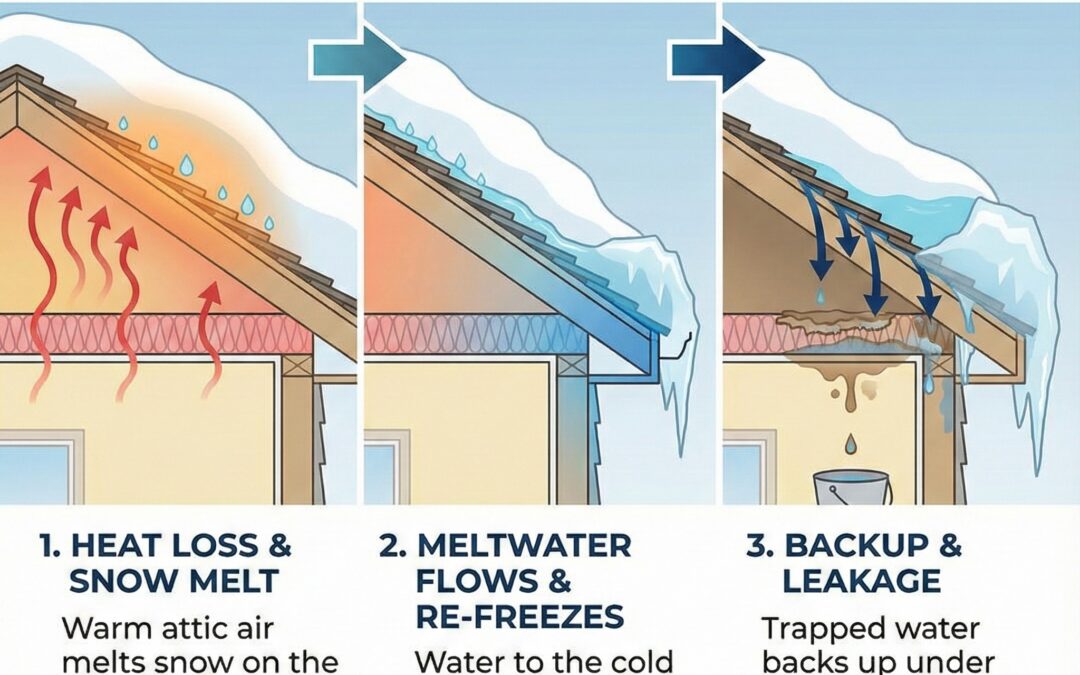
In winter, freeze–thaw cycles in Franklin drive water into roof cracks by day and expand into ice at night, prying materials apart and fueling ice dams. With average January highs near 47°F and lows near 29°F, these swings are common in Middle Tennessee (NOAA climate normals, Nashville area).
What causes freeze–thaw roof damage in Franklin, TN?
- Thermal cycling: Repeated expansion and contraction stresses shingles, sealants, and fasteners.
- Frost wedging: Water in micro-gaps freezes and expands, widening cracks over time (National Park Service).
- Ice dam leaks: Meltwater refreezes at cold eaves, backing water up under shingles.
- Attic heat loss: Warm, moist air from living spaces melts roof snow from below, feeding ice dams.
- Flashing failure: Step, counter, and valley flashing can separate under freeze–thaw stress.
- Capillary action: Thin water films travel uphill under shingles and into nail holes when dams form.
Bottom line for roof repair Franklin TN: even tiny defects turn into leak pathways when temperatures ping-pong above and below freezing.
Why Franklin, TN sees more roof damage from freeze–thaw
Franklin sits in Williamson County within the Nashville metro, where winter days often climb above freezing and nights drop below. That diurnal swing is prime territory for repeated melt–refreeze. Average midwinter highs in the 40s and lows near 30°F mean snow can soften or melt during sunny afternoons, only to refreeze after sunset. Shaded north-facing slopes and wooded neighborhoods common in Franklin slow melting at the eaves, encouraging ice ridges that stress shingles and flashing.
Regional climate datasets show regular winter variability and frequent temperature crossings around 32°F in Middle Tennessee—conditions that elevate freeze–thaw risk for building envelopes (NOAA/NCEI) and the Southeast Regional Climate Center. As a result, winter roof maintenance in Franklin should prioritize sealing cracks, keeping gutters clear, and controlling attic heat loss to limit ice dam formation.
- Sun-exposed slopes can melt quickly; shaded eaves and valleys stay cold longer.
- Light snowfalls that partially melt and refreeze are particularly damaging.
- Wintry mix events (sleet/freezing rain) create slick layers that trap water.
Featured snippet summary: How small roof cracks become big problems
Water enters hairline defects during daytime melts, then expands by ~9% as it freezes at night, prying the gap wider. Repeated freeze–thaw cycles fatigue shingle adhesive strips, open flashing seams, and force water under the roofing system—leading to leaks, wet insulation, mold, wood rot, and costly repairs.
Early warning signs of freeze–thaw roof damage in Franklin
- Hairline shingle cracks, lifted tabs, or bare granule patches.
- Separated or rusty flashing at chimneys, walls, skylights, and valleys.
- Icicles forming behind gutters or ice ridges along eaves after snow.
- Attic moisture: damp insulation, musty odor, or frost on nail tips.
- Interior ceiling stains, peeling paint, or sagging drywall near penetrations.
Ice dams: the freeze–thaw multiplier in Middle Tennessee
Ice dams form when attic heat melts roof snow from below. Meltwater flows to colder overhangs, refreezes, and builds an ice ridge at the eaves. Water then pools behind the dam and, aided by capillary action, can wick up and under shingle edges, travel along underlayment laps, and enter nail penetrations. Without robust eave protection or an unbroken air/vapor control layer, that moisture finds its way into the deck and attic.
Best practices include air sealing ceiling penetrations, increasing insulation to reduce heat loss, and installing a self-adhered ice barrier underlayment with proper overlaps (often 3–4 inches horizontal/vertical) that extends a minimum of 24 inches inside the warm wall line at eaves per many manufacturer recommendations and model code guidance (Building Science Corporation). For persistent problem areas, consider widening the eave protection and improving balanced intake/exhaust ventilation.
Preventive checklist for roof leak prevention in Franklin, TN
- Schedule seasonal roof inspection Franklin TN: Book professional inspections every fall (pre-freeze) and spring (post-freeze) to find and seal micro-cracks and weak flashing.
- Attic ventilation targets: Aim for 1:300 net free area (NFA) of ventilation, balanced between soffit intake and ridge exhaust, to keep the roof deck cold and dry.
- Air seal the ceiling plane: Seal around can lights, bath fans, attic hatches, and top plates to curb attic heat loss that fuels ice dams.
- Insulation levels: Top up to local prescriptive R-values; verify even coverage to avoid warm spots that start melt channels.
- Ice-and-water shield: Use self-adhered membranes meeting ASTM D1970 at eaves, valleys, and penetrations.
- Gutter maintenance cadence: In Franklin’s leaf-heavy fall, clean gutters monthly from October–December, then once again in late winter and spring; confirm downspouts discharge away from the foundation.
- Tree trimming: Reduce overhanging limbs to limit debris and shade along north-facing slopes.
- Snow management: Use a ground-based roof rake to clear the first 3–4 feet above the eaves after major snow; avoid chiseling ice.
- Internal resources: Consider gutter cleaning services, attic insulation upgrades, and roof inspection Franklin TN to get winter-ready.
Materials and details that matter in freeze–thaw
- Asphalt shingles: Quality shingles with strong adhesive strips resist wind and thermal lift; replace brittle or cracked units promptly.
- Underlayment: A continuous self-adhered ice barrier at eaves/valleys provides a final defense during back-up events.
- Flashing systems: Properly stepped and counter-flashed transitions outperform caulk-only patches; metal movement demands correct laps and fastener placement.
- Fasteners: Nails must be correctly driven and seated; exposed or backed-out fasteners are common leak starters in freeze–thaw.
- Ventilation: Balanced intake and exhaust keep deck temperatures stable, reducing melt–refreeze cycles.
Roof type considerations in freeze–thaw
- Asphalt: Vulnerable at adhesive strips and nail lines; monitor for granule loss and tab lift.
- Metal: Sheds snow well; watch for exposed fasteners, panel seams, and transitions at chimneys/sidewalls.
- Cedar shakes: Can swell/shrink with moisture; ensure breathable underlayments and robust flashing.
- Tile/slate: Durable surfaces but prone to underlayment and flashing leaks if gaps or slipped tiles allow water entry.
Roof pitch and overhangs: local risk factors in Williamson County
Low-slope sections, long overhangs, and shaded north-facing slopes common in Franklin neighborhoods increase ice dam risk. These areas should receive extra eave protection, meticulous flashing, and diligent snow management after storms.
Why exposed or backed-out fasteners fail faster in freeze–thaw
Fasteners that sit proud of the surface create a capillary gap where meltwater collects. As temperatures drop, that water freezes, expands, and loosens the fastener further—widening the leak path. Inspect seasonally for shiny nail heads, re-drive to proper depth, and seal with compatible roofing cement or replace as needed.
Moisture and indoor air quality
Leaks wet attic insulation, collapsing fibers and reducing R-value. Persistently damp materials can raise indoor humidity and elevate mold risk, especially in closed winter homes. Manage moisture at the source and remediate quickly (EPA Moisture Control Guide)
Cost ranges for Franklin roof repairs caused by freeze–thaw
Actual pricing varies by roof type, pitch, accessibility, and material. The following ranges reflect typical Middle Tennessee conditions and can help you budget for winter maintenance and urgent fixes:
- Crack sealing and shingle swaps: $150–$400 for minor repairs on one area.
- Flashing repair/rebuild (chimney or wall): $300–$900 depending on complexity and masonry condition.
- Ice-and-water shield installation (partial eave upgrade): $8–$12 per linear foot or $800–$2,000 for a common eave section.
- Deck replacement (localized rot): $3–$6 per sq. ft.; a 200–300 sq. ft. area can reach $600–$1,800 plus finish materials.
- Emergency tarping: $350–$950 for 24-hour response, roof pitch and height dependent.
Disclaimer: Estimates are general guidance; request an on-site assessment for firm pricing. Explore roof repair in Franklin TN or emergency roof repair for next steps.
Book a same-week Franklin roof inspection. Call (615) 555-0123. Serving Williamson County—including Franklin, Cool Springs, and Brentwood—with 24-hour emergency tarping.
DIY vs. pro: safety and scope for roofing contractor Franklin TN
- Safe for homeowners: Ground-based roof raking, gutter cleaning from stable ladders, and visual checks with binoculars or a drone.
- Hire a pro: Steep-slope work, shingle replacement, flashing repairs, underlayment upgrades, and leak diagnostics with moisture meters or infrared.
Winter roofs hide hazards: slick algae, black ice, brittle shingles, and fragile flashings. A misstep can cause falls or void manufacturer warranties. Walking on icy roofs is hazardous and can void shingle warranties; use ground-based roof rakes and contact a licensed, insured roofing contractor Franklin TN for elevated work.
Local homeowner scenario: how a hairline crack escalates
A Franklin homeowner in Fieldstone Farms notices a faint ceiling stain after a light snow. They put off calling. Over six weeks of sunny days and freezing nights, an ice dam forms at the north eave. Meltwater finds a hairline shingle crack near the valley nail line, wicks beneath the tab, and refreezes nightly—ratcheting the gap wider. By March, 120–180 sq. ft. of attic insulation is wet, R-value drops by 30–50%, and decking around the valley darkens with moisture.
The repair grows from a simple shingle swap to a valley rebuild with new underlayment, 10–12 linear feet of ice-and-water shield, and limited deck replacement. Total costs shift from a few hundred dollars to $1,200–$2,500 plus repainting. A timely inspection and sealing could have kept this to a routine service call—and avoided the interior disruption.

Local proof points in the Nashville metro
Freeze–thaw issues tend to spike in shaded, tree-lined parts of Franklin. Homeowners in areas like Cool Springs and Fieldstone Farms often report icicles behind gutters after light snow plus sunny afternoons—the classic setup for ice dams and under-shingle water travel.
Future implications for winter roof maintenance in Franklin
Shoulder-season volatility matters most for roofing. NOAA datasets and recent National Climate Assessments indicate winters with frequent temperature swings around 32°F and occasional heavy precipitation events in the Southeast. For Franklin, that means persistent melt–refreeze days, more mixed-precipitation storms, and episodic heavy rain on snow—conditions that magnify ice dam risk and stress flashing details.
Expect wider adoption of enhanced self-adhered underlayments, improved shingle sealants, and ventilation strategies tuned for variable winters. Maintenance will remain the best hedge: pre-winter inspections, airtight ceilings, clean gutters, and targeted eave protection (U.S. National Climate Assessment) and (NOAA Climate Data).
Franklin homeowner FAQ
How quickly can freeze–thaw turn a small crack into a leak?
In some Franklin, TN cases, a hairline shingle crack near active eaves can become a leak within one season—especially with recurring ice dams and thermal cycling.
What’s the best immediate action if I see icicles or a ceiling stain?
Use a roof rake from the ground to reduce edge snow, protect interiors with buckets/tarps, and schedule an inspection. Avoid chipping ice or walking on slick shingles.
Will new shingles alone stop ice dam leaks?
No. Pair quality shingles with air sealing, adequate insulation, balanced ventilation, and eave ice barriers to limit melt and back-up.
Are metal roofs immune to freeze–thaw damage?
Metal sheds snow better than asphalt, but exposed fasteners, panel seams, and flashing transitions can still leak during ice-dam events if details are weak.
Can homeowners insurance cover ice dam leaks in Tennessee?
Sometimes. Policies vary, but HO-3 forms may cover sudden and accidental water damage while excluding deferred maintenance. Document promptly and contact your carrier; review policy specifics with your agent and the Tennessee Department of Commerce & Insurance consumer resources.
What ventilation and insulation levels help prevent ice dams in Franklin?
Aim for balanced ventilation at 1:300 NFA (soffit intake + ridge exhaust) and insulation at locally recommended R-values, with special attention to sealing air leaks at the ceiling plane.
How can I tell if my flashing is failing during freeze–thaw?
Look for rust streaks, lifted step flashing, gaps at counter-flash reglets, sealant cracking, and water stains in the attic adjacent to chimneys, sidewalls, and valleys after thaws.
Action plan: stop a roof leak Franklin before the next cold snap
- Book a same-week roof inspection in Franklin TN focused on cracks, lifted shingles, and flashing seams.
- Clean and test gutters/downspouts; correct slope and secure hangers or schedule professional gutter cleaning services.
- Install/verify ice-and-water shield at eaves/valleys and upgrade underlayment where needed.
- Air seal the attic and top up insulation; consider attic insulation upgrades for energy and roof protection.
- Balance intake/exhaust ventilation to keep the roof deck cold and dry.
- When to call immediately: Interior drips, widespread icicles behind gutters, sagging drywall, attic frost on nails, or visible ice ridges at eaves.
Analogy: a windshield crack and your roof
Think of a small crack in your car’s windshield. After a few cycles of warm days and freezing nights, that hairline spreads across the glass. Your roof behaves the same way: water enters micro-cracks, freezes, and expands—fatiguing shingle adhesive strips and nudging flashing joints apart until leaks appear.
Citations and additional resources
- Building Science Corporation — BSI-046: Dam Ice Dam
- National Park Service — Frost Wedging
- NOAA NCEI — U.S. Climate Normals (Nashville area)
- Southeast Regional Climate Center — Regional Climate Data
- U.S. National Climate Assessment
- EPA Moisture Control Guide
- National Roofing Contractors Association — Consumer Resources
Bottom line for ice dam removal Franklin
Freeze–thaw cycles in Franklin are unavoidable—but major roof damage is not. Treat small cracks like urgent maintenance items, keep gutters clear, harden vulnerable eaves and valleys, and improve attic air sealing, insulation, and ventilation. For fast help, schedule roof repair Franklin TN or 24/7 emergency roof repair today.
Book a same-week Franklin roof inspection. Free inspection estimates, quick scheduling, and a licensed, insured roofing contractor serving all of Franklin and Williamson County. Call (615) 555-0123.